

What are the different types of dental cleanings?
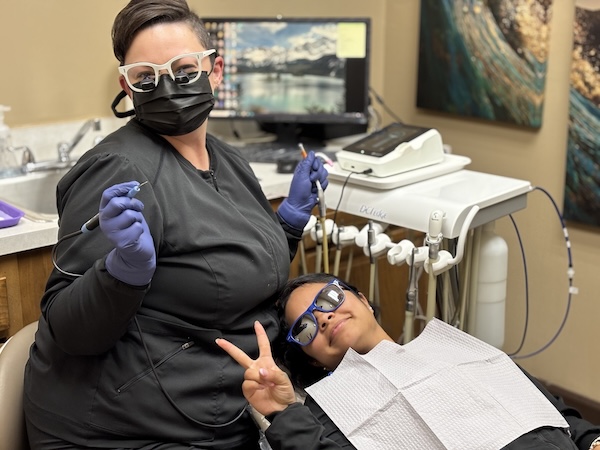
Patients usually get confused about this. There's a regular cleaning that usually happens once every six months. It's usually done above the gum line and a little bit underneath, but it's not really invasive. Then there's the deep cleaning that patients need when they have periodontal disease.
That cleaning is just the beginning part of the periodontal therapy that we offer, and usually that's a little bit more uncomfortable. We offer anesthetic with that, and usually it's done in two appointments for the patient's comfort. It can be done in one appointment, but we numb the patient. We go underneath the gum line, treat the area, and remove as much bacteria as we can. If needed, we can add medicine to help kill bacteria.
After that, the patient has to come back in six weeks for a check, and then every three months after that they'll come in for a maintenance appointment, which won't be done with anesthetic unless the patient needs it. It's pretty customizable, but from then on, the patient has to see a hygienist a little bit more often. Usually it's four times a year. Sometimes, if everything goes well, it's three times a year. But usually, if patients are diagnosed with gum disease, they cannot go back to a normal cleaning schedule unless their periodontal health improves enough for their dentist to recommend it.
Why are regular dental cleanings important?
Think about it as one of the most important parts of your dental routine. You wake up every day, you feel gross, and you want to brush your teeth. Then you eat all day long, and if you go to bed and don't brush your teeth, all of that bacteria is sitting in there and causing problems. That's why we say brushing before bedtime is so important.
As time goes by, sometimes we're tired and sometimes we don't do it every day. If you don't get a professional cleaning done, eventually your gums can get a little inflamed. They get swollen. You may even notice bleeding. Usually, that's what I hear from patients when they come in. I ask them, "What brought you in?" And they say, "Well, my teeth are bleeding." Teeth usually don't bleed, but gums do.
That gives me an idea that they may need a good cleaning. We will usually take a look and assess what type of cleaning they need. Maybe they'll need initial periodontal therapy. I always tell them that dental cleanings are very important because they help you maintain your teeth and gums over time.
How often should I have a dental cleaning?
The answer is, it depends. If you're a healthy periodontal patient, every six months is good. If you're not a healthy periodontal patient, then you probably have to get checked first, and the doctor has to develop a treatment plan that's catered to you.
A lot of my patients, as I call it, graduate. They start out seeing a hygienist every three months, and then they get better. They do a better job at home, and sometimes they can graduate to every six months. It really depends on the patient.
Is a dental cleaning painful?
Well, it depends on the patient. The first question I will have, especially if the patient hasn't been in for a while, is, "Have you ever been hurt? Why are you not going back?" A lot of times, you'll get a yes. They'll say, "I don't like getting them done. It hurts."
It can be uncomfortable, but it doesn't have to be, and that's our goal. When your gums are healthy, it's generally more comfortable. But when your gums are not healthy, there can be some discomfort. Our goal is to make it comfortable and, at that point, kind of graduate to better gums.
Gums are very forgiving until they're not. It takes a little bit of time and patience, and there can be a little bit of discomfort. It's kind of like if you don't work out and then you go to the gym. Your muscles hurt and you feel yucky, but as you do it more and more, it gets better. It's similar with your gums. As they get healthier, cleanings can become more comfortable.
How long does a typical dental cleaning take?
Well, the answer is, I don't know. It really depends on the patient and what they have. If it's a patient who hasn't been in for a while, typically 40 minutes would be sufficient for a hygienist. With a lot of the tools that we use, it's usually a powered instrument with water, which speeds up the process. Then they usually go in with hand instruments.
I would say 30 to 40 minutes for a regular cleaning. If it's a kid, it's a lot less. Obviously, if it's somebody with advanced periodontal disease, it can take an hour and a half.
What happens during a dental cleaning?
Well, you get seated in the hygiene chair. Sometimes there are X-rays that need to be taken so we can check if there are any problems going on or any tartar buildup. Then usually the hygienist will use an ultrasonic instrument that sprays water.
Sometimes patients with gum recession are sensitive to that. We usually ask if there are any sensitive areas, and if they prefer not to use that instrument, we won't use it. After the ultrasonic removes a lot of debris, we go in with hand instruments for another few minutes to clean things up.
Then you get your polishing toothpaste of choice, raspberry, mint, whatever you want. That's kind of the nice part. It tickles a little bit around your gums, but it feels good. That's when you get that nice, fresh feeling. Flossing is obviously involved. Then we always offer fluoride treatment at the end, and we suggest it for our patients, whether they're children or adults.
Can a dental cleaning damage your teeth?
We get that question a lot because patients sometimes tell us, "Oh, don't touch this tooth because it's so loose. You're going to wiggle it out with a dental cleaning."
Normally, no. Dental cleaning does not damage teeth because we are not stripping enamel off. We're removing bacteria and biofilm. However, if you do have some conditions underneath the plaque that we cannot see, cleaning the area can reveal sensitivity.
You cannot leave that plaque on your teeth indefinitely. We do have to clean it at some point, but then we obviously have to address the underlying problem. So, dental cleaning does not normally damage teeth, but it can expose some underlying issues. If you didn't know you had them, you might be surprised, and then we need to talk about how to address them.
How do I treat sensitive teeth after a dental cleaning?
That's actually very common. The first thing we do is look at the X-rays. If we see that the patient has bone loss, gum loss, or a lot of gum recession and the root surface is sensitive, we may recommend a special toothpaste they can use, depending on how severe it is.
Sometimes I'll put the patient on that toothpaste daily for two or three weeks. They just use it as a regular toothpaste. It is a prescription toothpaste, so the patient needs to get it through a pharmacy or dental office under a dentist's direction. Usually, that takes care of it.
The other thing is avoiding whitening toothpaste or other abrasive products, as well as whitening products afterward, because sometimes the gel can touch a sensitive area. We tell patients what to do and what to avoid. It's pretty easy.
If you're ready to schedule an exam or would like to learn more about our services, we'd love to hear from you. Call us at (636) 434-1244 or email [email protected]. We look forward to caring for your smile.